
Space Weather
Situation Report, April 07, 2026
Situation Report, April 07, 2026

Energy Supply
Space Operations
Communication

Navigation
Examples of Effects
The warning scale is based on the scale used by the National Oceanic and Atmospheric Administration (NOAA, USA) and comprises five levels, ranging from 1 (mild) to 5 (extreme). Statistically, extreme events occur one to four times per solar cycle. A cycle lasts 11 to 13 years.
|
D | Disturbance Storm Time (Dst) Index
The Dst Index is a primary gauge for geomagnetic storm severity, derived from a worldwide network of near-equatorial magnetometer stations. It calculates the globally averaged disturbance in the horizontal (H) component of Earth's magnetic field. As solar storms inject energetic ions into the magnetospheric ring current, they create a magnetic field that directly opposes Earth’s field, pushing Dst values deeply negative. |
|
||||||||||
|
E | Electron Flux
The NOAA SWPC tracks the outer radiation belt using geostationary GOES satellites to issue Electron Flux Alerts. Warnings are activated when the >=2 MeV electron flux exceeds 1,000 pfu for three consecutive 5-minute intervals. This indicator warns operators of deep-dielectric charging, where accumulated internal electrical charges in spacecraft components can cause sudden arcing, leading to phantom commands or permanent satellite damage. |
|
||||||||||
|
F | Solar Radio Flux
A parameter to which we actively contribute using the Solar Flux Telescope (CLT). Similar to the case of X-rays (see R-scale), the amounts of energy emitted during solar flares are reflected in the measurements of solar energy flux as so-called radio bursts. If the measurements increase abruptly, they are converted to the warning scale according to the following scheme: Increase in solar flux greater than: |
|
||||||||||
|
G | Geomagnetic Storms
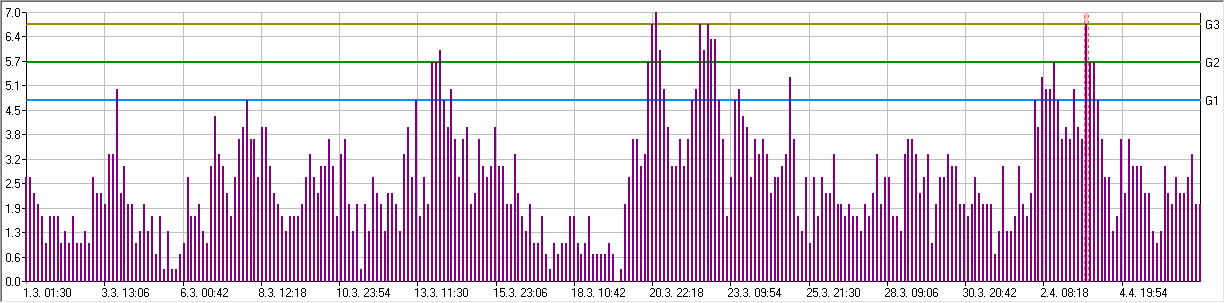
The NOAA SWPC uses the G-Scale to categorize the severity of Geomagnetic Storms caused by solar wind variations. The scale directly maps to the planetary Kp-index, ranging from G1 (Kp = 5) up to G5 (Kp = 9). It serves as a vital operational warning system for power grid operators regarding transformer damage, pipeline engineers tracking corrosive currents, and satellite flight dynamics teams monitoring increased atmospheric drag and surface charging. |
|
||||||||||
|
I | Electron Content
Total Electron Content (TEC) is the integrated electron density along a signal path through Earth's ionosphere, measured in TEC Units (TECU). Rapid increases in TEC, driven by solar EUV/X-ray flares and geomagnetic storms, directly modify the refractive index of the upper atmosphere. This causes signal phase delays and range errors for Global Navigation Satellite Systems (GNSS/GPS), high-frequency (HF) radio degradation, and satellite-to-ground communication disruptions, making it a critical metric for precision aviation and maritime navigation. We determine the total electron content using our own GNSS measurements. |
|
||||||||||
|
R | X-Ray Flux
The NOAA SWPC uses the R-Scale to categorize Radio Blackouts caused by sudden solar flare X-ray emissions. The primary metric is the peak X-ray flux measured in by GOES satellites, mapping directly to flare classes from R1 (M1 class) up to R5 (X20 class). It warns maritime, aviation, and military operators of sudden ionospheric absorptions that block HF radio communication and cause positioning errors in low-frequency navigation systems. |
|
||||||||||
|
S | Proton Flux
The NOAA Space Weather Prediction Center (SWPC) uses the S-Scale to categorize Solar Radiation Storms. The primary metric is the elevated proton flux (>=10 MeV), measured in Particle Flux Units (pfu) by GOES satellites. Stoms range from S1 (>=10 pfu) to S5 (>=100,000 pfu). It warns industries of polar HF radio communication failures, spacecraft orientation errors, and heightened radiation hazards. |
|